
The connected data space for the racquet sports ecosystem.
Racquet sports are a multi-billion market that still decides on instinct. RacqI wires venues, operators, operator types, financials, regulation and location into one structure — across five sports and 220+ countries.
Sourced, calculated, or named. Never guessed.
RacqI in one minute.
Rachele Gaebel, founder of RacqI, shows what the platform connects — and why it opens up the knowledge of the racquet sports ecosystem instead of inventing it.
1 minute · with sound · EnglishRead the transcript
I'm Rachele, founder of RacqI. Racquet sports are a multi-billion market, and they still decide on instinct. Let me show you what we built.
More than five hundred data points shape this market. Population. Wealth. Climate. Regulation, and many more. We collect them, verify them, and wire them into one structure.
And when the market moves, you get the signals before you ask.
We know exactly what characterises every facility. The ground to decide on — for investors, operators, federations and the public bodies.
We use AI to open up and connect the knowledge of the racquet sports ecosystem — not to invent it.
That's RacqI. Come and check for yourself.
The platform build is finished and running — Atlas, Sentinel and Simulator are live, on the Persona lens. The evidence base is filling, with daily intake — and coaching is being added as its newest area. Pre-beta access is live.
Separate worlds become one structure.
The data this market needs already exists — in company registers, statistical offices, filed accounts, standards, zoning plans and trade press, in every language and every format. RacqI reads it, resolves it and wires it into one structure you can move through.
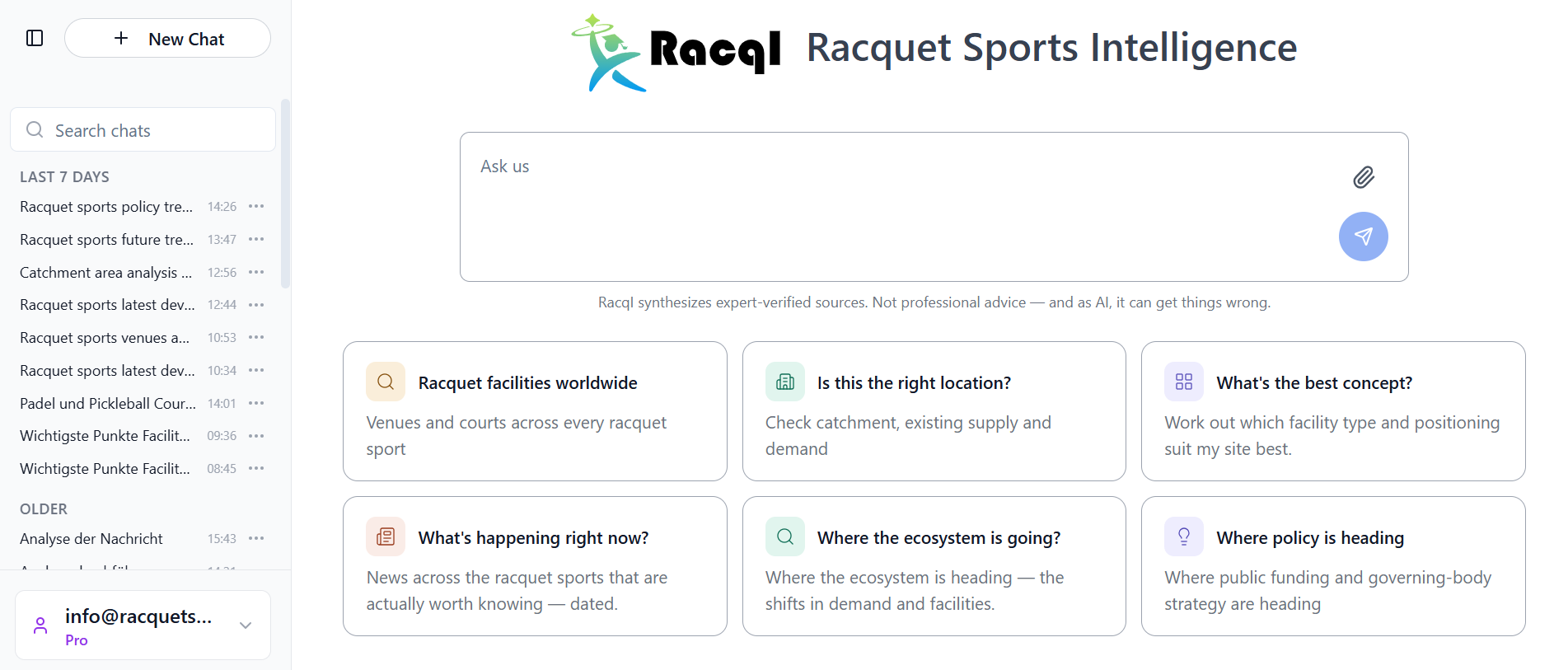
Ask anything in racquet sports and get a sharp, decision-ready answer — every figure sourced, calculated, or named as an assumption, never guessed. Need more, a full report follows on demand; on broad questions the Next Steps pillar maps out where to go from here.
The sharpest questions reach outside the sport: how many indoor courts a site needs for its number of rainy days, or what pricing holds at the local leisure budget. RacqI reads racquet-sports data against climate, demographics and spending — answers the sport's own numbers cannot give alone.
One foundation. Three engines. One lens.
One evidence base, read three ways — and framed for the decision you actually hold. Not three products, and never a second database underneath.
Supply and white space
Where is a market under- or over-supplied? Facilities and courts measured against population and a maintained benchmark, ranked by white space — and weighted by the kind of operator behind each venue wherever that is established. Computed in code, on structured data; the language model never does the arithmetic.
The map of the gaps — evidenced, not estimated.Radar and early warning
What changed in your market that concerns you? New and changed venues, regulation, standards and trade media, checked every day against the sports and regions you follow. The first part of RacqI that acts without being asked — a padel centre opening three kilometres away reaches you before you think to look.
You no longer need to know what to ask.What-if and payback
What does it return to build here, or to extend? Set the site, define the offering: expected utilisation, revenue, CapEx, OpEx and payback — with the competition in the catchment and the cannibalisation of your own venues. Every parameter sits on a slider and recalculates live.
Not a forecast. A transparent calculation you turn yourself.Not a fourth engine. The axis the other three run on.
Two axes, deliberately kept apart: what the question is about — your facility, the market around it, or the database of facilities — and who is asking: operator, investor, manufacturer, federation, municipality. That decides which engines open, which decisions count, and in what framing the answer arrives.
And it stays a lens, never a filter. Ask how padel is developing in Europe and a Southern-Europe focus prioritises the answer — it does not quietly narrow the question to Southern Europe. Where the lens sets an assumption, it names it on the surface, and you can override it.
Same evidence base. Your decision.Five sports on paper. One business underneath.
The common denominator is not the sport — it is the facility. Catchment, court mix, utilisation and cost base behave the same way across all five, which is why RacqI reads them as one market.
Fastest growth, thinnest evidence — booming where, for whom, at what price.
Social by design, low barrier to entry, increasingly built indoors.
The established base — and the land most conversions start from.
High court density per square metre; a different utilisation curve entirely.
Small footprint, loyal base — often the filler that makes a court mix work.
The venue is the asset, not the sport
Coaching, players, tournaments and equipment each need somewhere to happen. That somewhere is a defined area, a surface, most often a building — a decades-long capital commitment, and where money is committed and earned back. Roughly 80% of the sector's value is generated there — the professional tennis circuit aside.
Sport-by-sport is a federation habit
The market still thinks tennis-in-tennis, padel-in-padel. For a governing body that holds. For capital it is simply the wrong unit of analysis — and it leaves every cross-sport comparison unavailable.
Multi-sport facilities are the future
Venues already mix padel, pickleball and racquet formats under one roof to spread fixed costs and fill more hours. Court mix becomes a decision in itself — and the silo view cannot answer it.
A facility is a twenty-year bet placed in an afternoon.
What RacqI exists to changeFacilities do not fail at random. They fail at four basic decisions — each of which can be established before a single court is laid.
A directory sees two venues. RacqI sees two different businesses.
A municipal non-profit court and a commercial padel centre two streets apart are not the same market. Same catchment, same sport, opposite logic — different pricing, a different utilisation curve, different opening hours, a different capital requirement. A national training academy is not a leisure centre. Both have courts. Neither is competing for the same customer.
RacqI knows not only who operates a venue, but what kind of operator they are — commercial, municipal, non-profit, club, school, academy. Where the operating basis is established, the calculation counts the venue as what it actually is. Where it is not, the answer flags it rather than assuming.
This is where the money is decided. Supply and white-space analysis is simply wrong if a school gym counts as equivalent competition — it overstates saturation and kills sites that would have worked.
Counting courts is not measuring competition.Every site has a ceiling
Catchment, purchasing power, age structure — and competition, which is where most site analysis goes wrong. Build above the ceiling and the courts never fill; below it and the return was left on the table. It is rarely calculated. It is assumed.
Decide what it is for
Social hub, performance centre, premium club, tournament venue — each demands a different court mix, programme and staff. A facility that tries to be all of them is none of them.
There is a right number
Fixed costs barely move between three courts and eight. Too few and they can never be carried; too many and they stand empty at exactly the hours meant to pay for them.
Facts, or hope
Construction cost is negotiated line by line; twenty years of operating cost gets a single line. Revenue is projected from what the plan needs to earn. It looks like a calculation.
Racquet sports became an asset class. It is still being run on instinct.
The sector has run on instinct for fifty years. For forty of them, the Racquet Sports Institute has been recording what actually happens inside these buildings — what a court costs to run, which mix fills, which site empties. That record is the reason RacqI can exist now. It was never available to anyone else.
The platform is built. Ask for your access.
Pre-beta access is live, arranged individually. Commercial launch October 2026.
Racquet Sports Intelligence. The connected data space for the racquet sports ecosystem — five sports, 220+ countries. Sourced, calculated, or named. Never guessed.